
Mother plant · M09
Anthurium papillilaminum 'Peach' × DPN
House reference Peach
Not for sale · her clones are
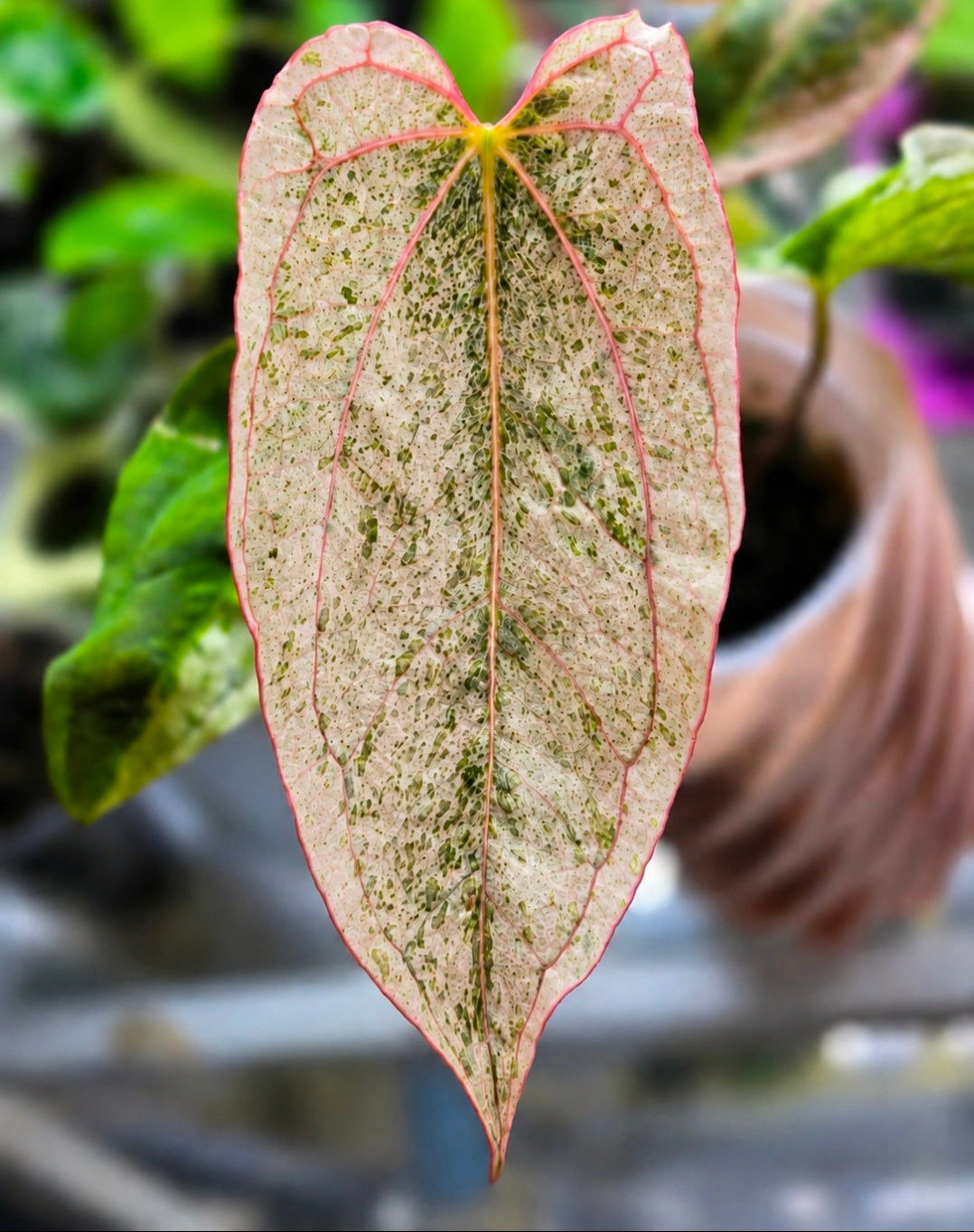
The specimen
Almost no green left.
Peach is a papillilaminum selection carrying warm pink to apricot pigment in place of the usual green base.
On this plant the pigment covers nearly the whole blade, with red venation running through it and only scattered green tissue remaining.
Variegation at this percentage is visually extraordinary and biologically fragile. She is grown slower and brighter than the rest of the collection for that reason.
What is behind her
Where each trait comes from.
A cross is not a blend. Each parent decides different things, and knowing which one is responsible for what tells you a great deal about how a clone from her will grow out.
Papillilaminum, Peach
A papillilaminum selection carrying warm pink to apricot pigment in place of the usual green base tissue. This is not variegation in the ordinary sense of white or cream sectors, it is a warm-toned expression across the blade, often with red venation running through it. Coverage varies from scattered to nearly complete, and high-coverage plants are correspondingly fragile because there is less green tissue doing the work. It keeps the elongated leaf shape and matte surface of the species. Expect warmth rather than contrast, slower growth than a green plant, and a specimen that wants brighter light than its parents to hold the colour.
Dark Phoenix, DPN
Dark Phoenix is a dark papillilaminum line, widely stated as papillilaminum crossed with dressleri, though it has never been formally registered and the parentage is not universally agreed on. What is not in dispute is what it does. New leaves emerge a rich reddish brown and harden to something very close to black with a matte finish, and that emergence is the reason people grow it. The letter after the name marks a nursery selection within the line rather than a different plant, which is the same convention that gives us RVDP, the red-veined selection out of the same line. In a cross it contributes darkness and dramatic new growth rather than a distinctive outline. Expect a plant worth watching while a leaf hardens, not only once it has settled.
The photograph is not an illustration of what your plant might become. It is the specification.
What a clone from this mother is
Not a seedling. Not a cross. The same plant.
- Every specimen released under Peach is a rooted clone taken from the plant on this page. No seed. No variation lottery.
- Genetically identical. Same variegation genetics, same leaf architecture, same growth habit.
- What you see above is what yours becomes.
- Grown in Sweden from propagation onward. No import shock between her and your plant.
All variegated aroids carry long-term reversion risk, and no grower can honestly promise otherwise. What you get is her exact genetics and her documented track record, not a guarantee about every future leaf.
Released from this mother
Her clones, when they exist.
She is not always in propagation. When a clone is ready it is listed here first.
See what is available nowNothing listed means nothing is ready. That is deliberate.
Tell me when Peach produces.
One email, only about this mother, only when a clone from her is ready. Nothing else.
We keep a separate list per mother, so you only hear about the plants you asked about.
You are on the list for Peach.
You will hear from us the day a clone from her is ready, before it goes public.
Released from this mother
Taken from Peach.
Each of these is a rooted clone from the plant above. Same genetics, same leaf architecture, grown on here before release.
Availability changes without warning. Nothing here is reserved until checkout is complete.