
Mother plant · M22
Anthurium (papillilaminum × (Michelle × Zara)) × Red Phantom
House reference Nova
Not for sale · her clones are
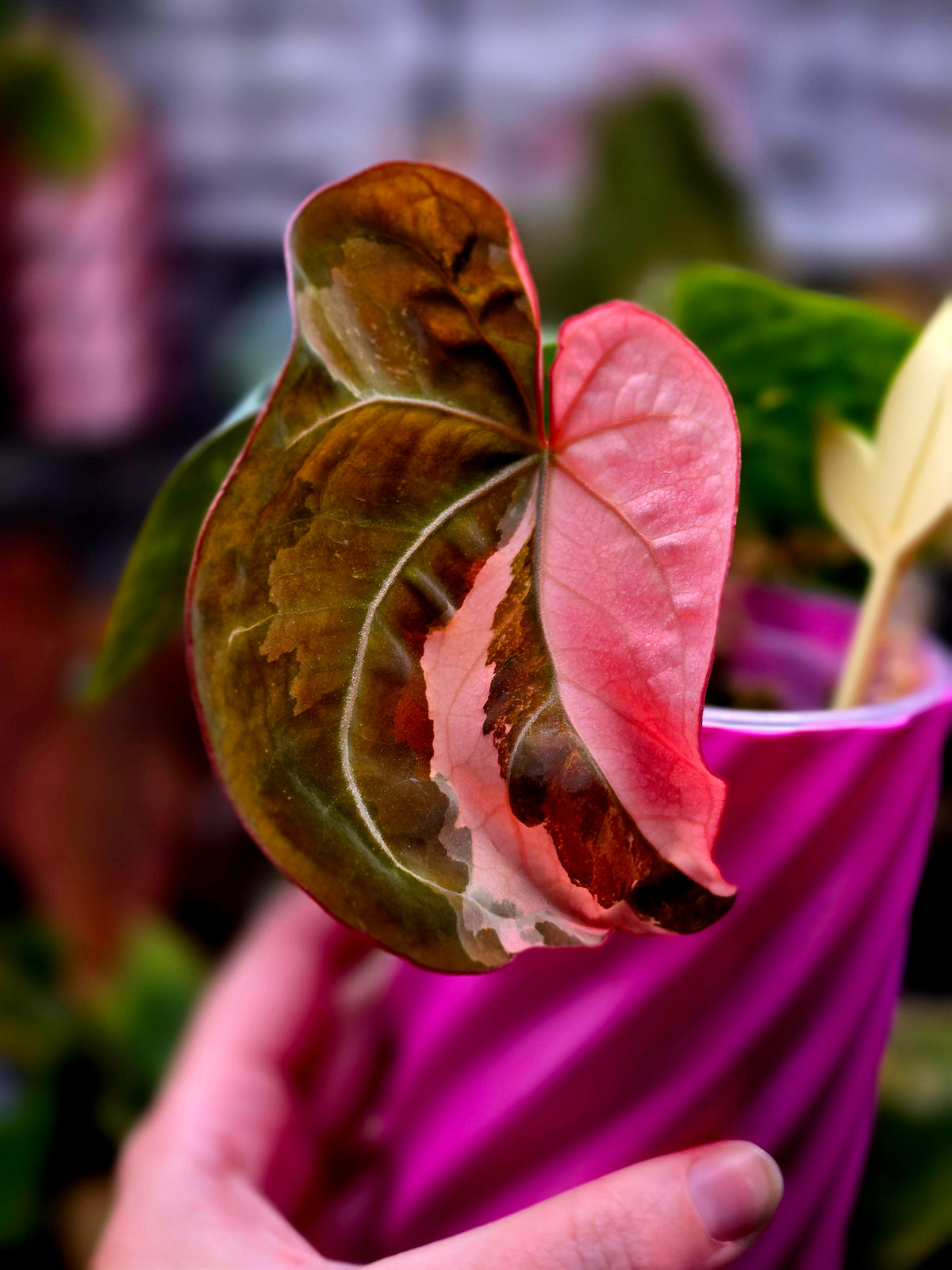
The specimen
Orange that cools into mint.
Papillilaminum sits on both sides of her, and Michelle already runs through this collection. Eight listings released from here have carried Michelle as a parent. Red Phantom brings the warmth.
The transition is the point. A new leaf pushes bronze and orange, moves through pink, and settles into mint rather than into plain green.
She has been on the bench here since January 2026.
What is behind her
Where each trait comes from.
A cross is not a blend. Each parent decides different things, and knowing which one is responsible for what tells you a great deal about how a clone from her will grow out.
Anthurium papillilaminum
The backbone of modern velvet breeding, and the parent most likely to decide what a hybrid looks like. It comes from Panama and carries a long, elongated blade rather than a wide heart, with deep basal lobes that open rather than close. The surface is true matte velvet, so it absorbs light instead of reflecting it, and pale venation reads faintly in ambient light and sharply from the side. Petioles are round, which is part of why it crosses so readily with other round-petioled species. It brings substance, meaning the leaf feels thick and holds its shape as it hardens. Expect length over width, a matte finish rather than gloss, and a plant that gets noticeably better as it matures rather than peaking early.
Michelle
A named hybrid used widely as a variegation donor. It is grown for the tendency to throw stable sectoral variegation in cream to pale yellow, and it passes that tendency on more often than most parents do, which is why it appears in so many variegated crosses. Leaf shape is a broad velvet heart with moderate vein contrast. The variegation it contributes is sectoral rather than speckled, meaning defined blocks rather than scattered flecks. Expect the pattern to come from this side. As with all variegation, tendency is not a guarantee on any individual seedling.
The photograph is not an illustration of what your plant might become. It is the specification.
What a clone from this mother is
Not a seedling. Not a cross. The same plant.
- Every specimen released under Nova is a rooted clone taken from the plant on this page. No seed. No variation lottery.
- Genetically identical. Same variegation genetics, same leaf architecture, same growth habit.
- What you see above is what yours becomes.
- Grown in Sweden from propagation onward. No import shock between her and your plant.
All variegated aroids carry long-term reversion risk, and no grower can honestly promise otherwise. What you get is her exact genetics and her documented track record, not a guarantee about every future leaf.
Released from this mother
Her clones, when they exist.
She is not always in propagation. When a clone is ready it is listed here first.
See what is available nowNothing listed means nothing is ready. That is deliberate.
Tell me when Nova produces.
One email, only about this mother, only when a clone from her is ready. Nothing else.
We keep a separate list per mother, so you only hear about the plants you asked about.
You are on the list for Nova.
You will hear from us the day a clone from her is ready, before it goes public.
Released from this mother
Taken from Nova.
Each of these is a rooted clone from the plant above. Same genetics, same leaf architecture, grown on here before release.
Availability changes without warning. Nothing here is reserved until checkout is complete.